Roman Britain
Heart of DarknessRoman Britain is the historical point of comparison in Charles Marlow’s opening account of imperial conquest. Recalled on the Thames, the Roman arrival in Britain lets him contrast the precarious light of modern civilization with an older darkness, while exposing the force, hardship, and self-justifying ideals beneath imperial expansion.
A Roman frontier imagined from the Thames
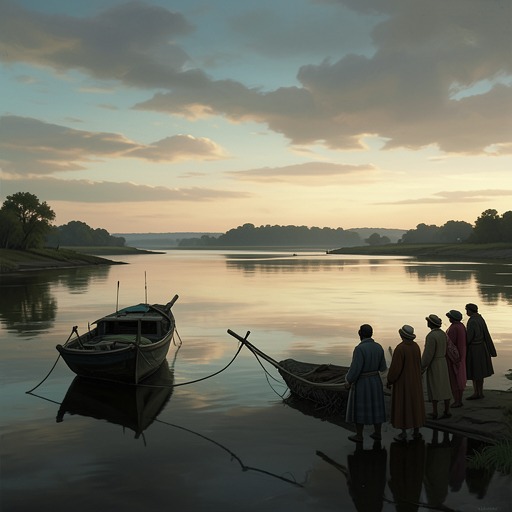
Marlow places the Roman arrival in Britain nearly nineteen hundred years in the past, then ironically calls it the other day. From the present-day river, he imagines a Roman commander diverted from the Mediterranean and sent north across Gaul with legionaries aboard a small, rigid vessel. The journey ends at what Marlow presents as the edge of the known world: a lead-colored sea, a smoky sky, and a river route into an unfamiliar country.
His account sets contemporary illumination against that imagined past. Light, he says, has come from the river since the Romans, but modern life occupies only a flicker between darkness and the old earth’s continued turning. The contrast is not a straightforward celebration of progress. The present’s apparent brightness is fragile, and the Roman past remains close enough to unsettle any confident division between civilized light and historical darkness.
The hardships of occupation
Marlow imagines the Roman force moving upriver with supplies or orders through sandbanks, marshes, forests, and sparse sources of food. There is no familiar wine or easy shore leave; isolated military camps sit within wilderness, while cold, fog, storms, disease, exile, and death threaten the newcomers. The commander may endure these conditions competently, Marlow suggests, but could later turn the ordeal into a boast and hope for promotion to the fleet at Ravenna if he survives and has influential friends in Rome.
A second imagined figure, a young citizen in a toga, comes north in the retinue of a prefect, tax collector, or trader to improve his fortunes. He lands in a swamp, travels through woods, and finds himself enclosed by a life he cannot understand. Marlow emphasizes that there is no initiation that makes this wilderness intelligible: the newcomer must live amid what he finds incomprehensible and repellent, even as it exerts a fascination. In his account, occupation is therefore not simply a military undertaking; it is an encounter that tests the occupier’s composure and capacity to maintain a sense of order.
Conquest, force, and moral pretext
Marlow distinguishes Roman conquerors from colonists and describes their administration as extraction rather than settled governance. In his formulation, conquest requires brute force, but possessing superior force is no achievement in itself when that strength depends on others’ weakness. The Romans seize what can be taken for the sake of the taking; he characterizes the result as violent robbery and large-scale killing, carried out without clear sight of what such an incursion means.
The qualification that follows is central to his argument: conquest can be redeemed, in Marlow’s view, only by an idea behind it and an unselfish belief in that idea. He rejects sentimental pretense as sufficient; the idea must be something people can serve and sacrifice for. The Roman example thus supplies both a condemnation and a difficult standard. Material acquisition and force alone cannot provide moral legitimacy, while the language of a higher purpose remains vulnerable to being no more than an excuse.
Narrative and historical significance
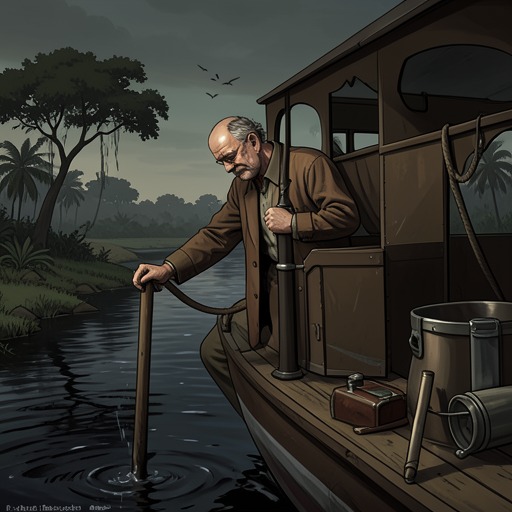
The Roman episode is not a separate account of Britain’s history so much as a frame for Marlow’s larger reflection on imperial ventures. Its movement from the Thames to an imagined Roman river expedition prepares the transition to his own experience on the Congo River. There, the wilderness again appears to unsettle European expectations, and the practical demands of travel compete with attempts to impose a reassuring meaning on what is encountered.
By beginning with Roman Britain, Marlow makes imperial darkness neither uniquely African nor safely confined to a remote past. The comparison complicates the notion that modern European power simply carries light into darkness: Britain itself was once imagined as the forbidding frontier reached by an invading force. His meditation therefore places the language of progress beside the material facts of conquest, asking what, beyond strength and gain, could make domination defensible.